Engine Modifications
The Rover 1.8 K series engine in standard form produces in the region of 126 bhp and 127 lb/ft of torque. It can be tuned to develop anything up to 250 bhp as achieved by Peter Carmichael. This figure is 20 bhp more than Caterham and Minster managed with the R500 engine. A more realistic figure for a 1.8 K with DTH throttle bodies, uprated cams, bigger valves and a ported head is around 200 bhp. I am aiming for a figure of around 190 bhp as my initial intention is to stay with hydraulic tappets and use Piper 285H cams which have ben developed specially to use with hydraulic tappets.
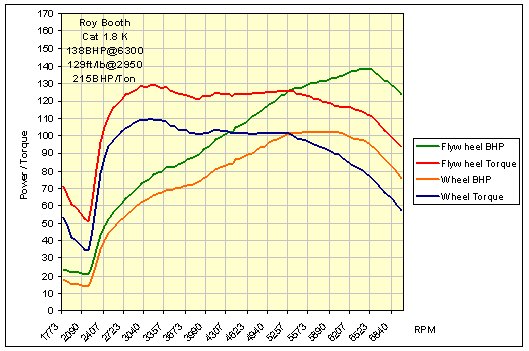
But first I'd like to start by showing you the power and torque curves for the starting point, a bog standard wet sump Rover 1.8K series engine. The car was put on the rolling road at Emerald in it's standard trim so that I could measure improvements that certain modifications made in terms of increased engine performance.
Standard Rover 1.8 K series with Rover MEMS ECU
Here's what happened when we plugged in an Emerald 16 Bit ECU with a standard 1.8K map. As you can see power is up from 126 BHP to 138 BHP while torque is up from 127 lb/ft to 129 lb/ft. This is very close to supersport figures for half the price.
Standard Rover 1.8 K series with Emerald 16 Bit ECU
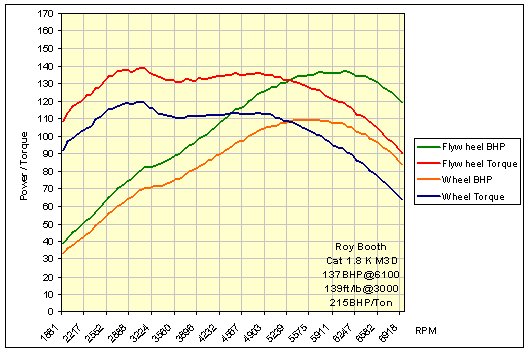
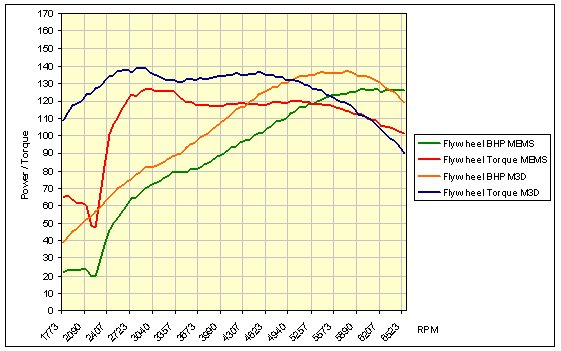
On the second rolling road day my 32 Bit Emerald had a full mapping session with Dave Walker and Karl Paton and it can be clearly seen what proper mapping can do. The significant dip in power and torque up to 2500 RPM which was evident on the Rover MEMS and the unmapped Emerald 16 Bit has completely gone in the fully mapped graph. This smoothness of power delivery is evident when driving the car on the road or track, it will pull virtually from idle all the way up to 6,500 RPM.
Standard Rover 1.8 K series with Emerald 32 Bit ECU
To make it easier to compare the two graphs I've combined the data for the flywheel figures onto a single graph.
Power and Torque Graph comparison between MEMS and M3D